
Home » 29th Report on the State of Substandard Housing in France
On February 1, the Abbé Pierre Foundation released its 29th report on the state of substandard housing in France, which highlights the issues of precarious housing and homelessness. In the report, the foundation analyzes public housing policies andcommentson thestatistics regarding substandard housing.
As 2023 marks the 70th anniversary of Abbé Pierre’s appeal, the housing crisis is having increasingly devastating economic and social consequences for the most vulnerable populations, leaving thousands of people homeless or living in precarious conditions.
The alarming figures recorded in 2023 highlight the scale of the crisis, particularly in termsof unpaid rent, unmet housing requests, and homelessness.
There has been a significant increase in the number of people without housing, even as an average of 1,340 children are left without shelter each night. Unmet requests to the 115 hotline have risen, with 8,351 people with unmet requests each night, including 2,800 requests for housing from children, compared to 920 in the fall of 2020.
Access to public housing is also deteriorating, particularly for the lowest-income households, despite the “Housing First” policy. 2.6 million households are on the waiting list for public housing, with demand exceeding the annual housing supply by a factor of 4 to 5.
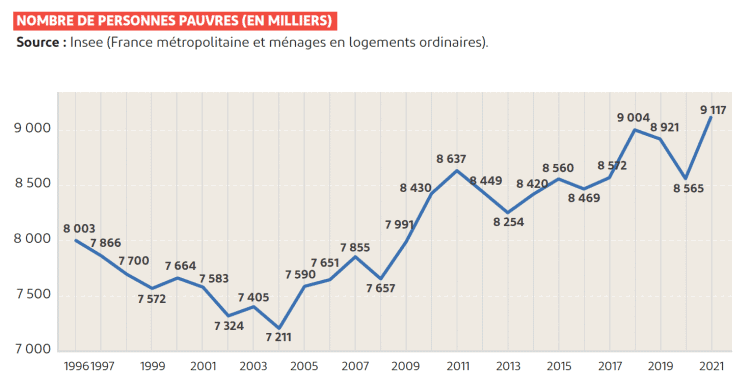
This housing crisis is unfolding against a backdrop of rising insecurity and poverty, with increasing unemployment and inequality. The figures also reveal a significant increase in the number of people living below the poverty line: 9.1 million in 2021, or 1.5 million more than 20 years earlier. One notable consequence of this is an increase in the demand for food assistance.
Finally, warnings about the housing crisis are now reaching new groups. Students are facing rising rents: 36% of them regularly skip a meal, and 39% of them go without heat.
The report emphasizes that the measures taken remain insufficient to address the scale of the crisis and meet the urgent needs of the population.
Certain specific characteristics of the overseas territories, such as complex land tenure situations and a lack of legalization, contribute to an increase in the number of informal or spontaneous settlements, which are often precarious and substandard and are particularly widespread in Mayotte and French Guiana. According to the Ministry for Overseas Territories, substandard housing affects nearly 110,000 units out of a total housing stock of nearly 900,000 units (or 12%).
Informal settlements are constantly expanding, partly due to immigration from neighboring countries. The report, however, highlights a lack of rehousing options.
There are other forms of substandard housing, including traditional dwellings that no longer meet minimum standards of decency. France’s overseas territories also face challenges related to the construction of public housing.
Finally, climate change is exacerbating the situation by increasing residents’ exposure to extreme weather events such as floods, droughts, and storms. Policies to address substandard housing must therefore adopt a multidimensional and inclusive approach to ensure sustainable and equitable solutions.
The Abbé Pierre Foundation provides an estimate of the number of people affected by substandard housing in France, based on data from INSEE’s 2013 National Housing Survey (ENL) and preliminary results from the 2020 ENL, as well as administrative data.
According to their analysis, 4.2 million people are living in substandard housing or lack their own home, while 12.1 million people are affected to varying degrees by the housing crisis.
Among those without their own housing, an estimated 330,000 are homeless, and 643,000 are living with others against their will.
In addition, 2,874,000 people live in very poor housing conditions, while 1,128,000 live in severely overcrowded conditions.
These figures are supplemented by 31,000 residents of migrant worker dormitories awaiting renovation and 208,000 people living in substandard mobile housing.
Trends point to a worsening situation for most indicators of substandard housing. For example, the number of homeless people has more than doubled since 2012, and the number of people living in severely overcrowded conditions increased by 16% between 2013 and 2020. More and more people are facing an excessive financial burden to pay for their housing, which is leading to an increase in utility disconnections and evictions.
Certain specific characteristics of the overseas territories, such as complex land tenure situations and a lack of legalization, contribute to an increase in the number of informal or spontaneous settlements, which are often precarious and substandard and are particularly widespread in Mayotte and French Guiana. According to the Ministry for Overseas Territories, substandard housing affects nearly 110,000 units out of a total housing stock of nearly 900,000 units (or 12%).
Informal settlements are constantly expanding, partly due to immigration from neighboring countries. The report, however, highlights a lack of rehousing options.
There are other forms of substandard housing, including traditional dwellings that no longer meet minimum standards of decency. France’s overseas territories also face challenges related to the construction of public housing.
Finally, climate change is exacerbating the situation by increasing residents’ exposure to extreme weather events such as floods, droughts, and storms. Policies to address substandard housing must therefore adopt a multidimensional and inclusive approach to ensure sustainable and equitable solutions.
770 years after Abbé Pierre’s appeal, housing is unfortunately still central to the dignity owed to people in need.